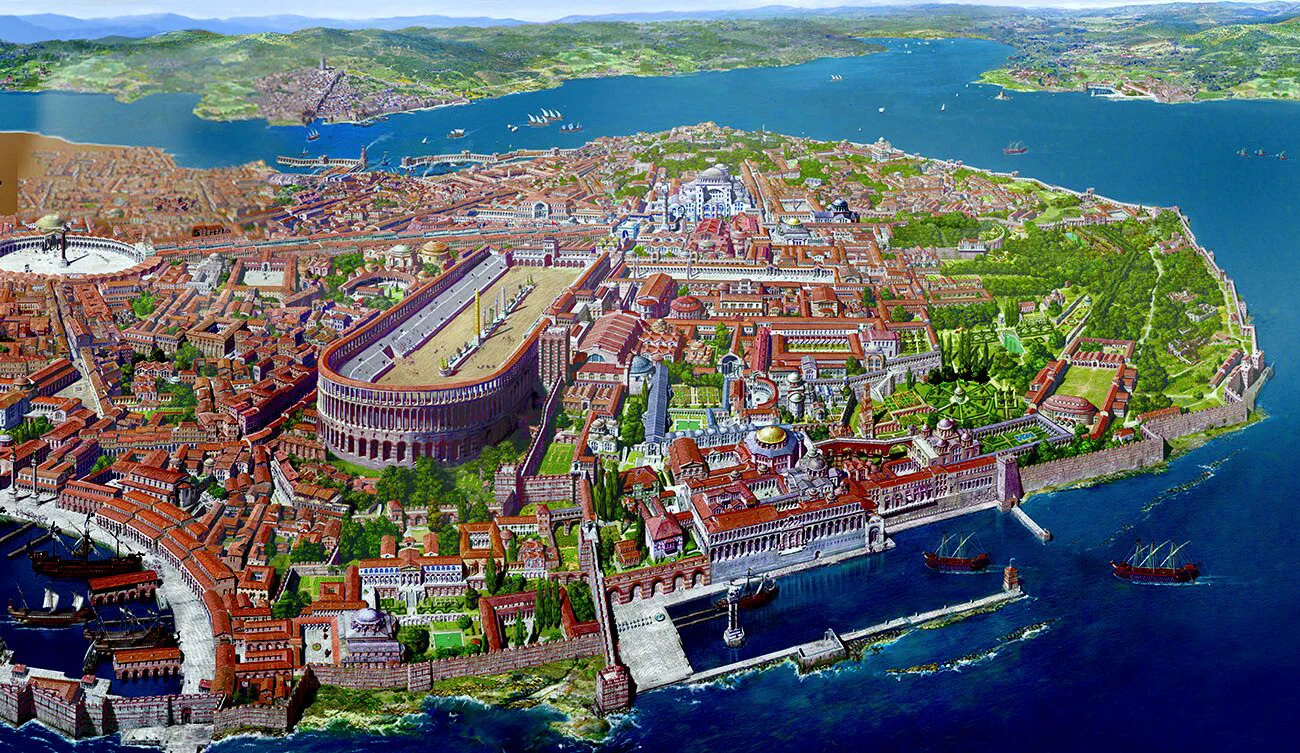
There is a reason people still love playing Byzantium in grand strategy games.
Europa Universalis. Crusader Kings. Pick your poison.
You start weak, surrounded, half-dead, usually one bad war away from deletion. And still, people pick Byzantium. Again and again.
Not because it is easy.
Not because it is optimal.
But because the name still has gravity.
Byzantium. Constantinople. The Roman Empire that refused to become a museum exhibit.
Even now, hundreds of years later, the word sounds bigger than the map. It carries more prestige than many kingdoms that survived longer, won more recently, or appear more often in school textbooks. There is something almost unfair about it. Mention Constantinople and half of European history walks into the room.
That is the point.
Prestige does not die when armies lose. Sometimes it survives the state that produced it. Sometimes it becomes even stronger precisely because the thing itself is gone.
And once we understand that, 1204 stops looking like just another medieval atrocity.
It becomes one of the great receipts of European history.
Not the only one.
Not the first one.
Not the single magic key that explains everything.
But a receipt.
A visible proof of a larger transaction.
A moment when the Latin West converted sacred violence, naval logistics, debt, plunder, trade access, and symbolic theft into durable geopolitical advantage.
The West Did Not Start as “The West”
We read European history backwards. The modern map tricks us.
France, Germany, Austria, Italy, Britain, Spain — they feel like the natural center of Europe. The “West” feels inevitable. The East feels peripheral, unstable, late, semi-European, permanently catching up. But that is the story written after the fact by the winners of the timeline.
For centuries, the surviving Roman state was not in Rome. It was in Constantinople.
The western half of the Roman Empire collapsed into Germanic kingdoms. The eastern half endured. It kept the imperial bureaucracy, the tax system, the cities, the court, the diplomacy, the ceremonial language, the Christian imperial imagination, and the claim to being Rome. The West had ruins. The East had continuity.
This matters because the later Western European story is not simply a story of organic growth. It is also a story of reconstruction, imitation, rivalry, resentment, and appropriation. The Frankish world rebuilt power in the West. The papacy learned to crown legitimacy. Charlemagne revived the imperial title. The Holy Roman Empire claimed continuity with Rome. Latin Christendom developed its own center of gravity.
But Constantinople was still there. A living contradiction. A Christian empire older, richer, more urban, more imperial, and more Roman than the new western claimants.
The theological break between East and West did not begin in 1204. The wounds were older, the rivalry was older, the distrust was older. The famous date in books is 1054, but schisms do not become real because someone writes them into a timeline. They become real when they acquire memory.
1204 gave the schism a body.
It turned an argument about authority into a memory of fire, rape, relic theft, partition, occupation, and humiliation. After that, “Christian unity” was no longer an argument.
It was an insult.
It Was Messy. It Was Also Civilizational.
A careful historian will object here.
And the objection is fair.
The Fourth Crusade was not “the West” acting like one modern geopolitical bloc. There was no board meeting where Europe approved the quarterly objective: “Steal Rome From the East.”
It was messier than that.
It was debt-ridden crusaders, Venetian state interest, Byzantine dynastic politics, papal weakness, aristocratic ambition, religious language, commercial calculation, bad incentives, and opportunism dressed as providence.
That is true.
But it is also not enough.
Because history often works exactly like that.
Civilizational interests rarely arrive wearing a uniform and carrying a signed strategy document. They arrive as merchant contracts, unpaid debts, ports, privileges, papal letters, dynastic claims, naval logistics, legal excuses, and men with swords explaining why this time the violence is unfortunate but necessary.
The Fourth Crusade was supposed to aim at Egypt and the Holy Land. But the crusaders contracted Venice for transport, too few crusaders arrived to pay the bill, and the expedition became financially trapped. Venice had built the fleet. Venice needed compensation. The first diversion was Zara, a Christian city, despite papal opposition. Then came Constantinople.
That does not make the sack less western.
It makes it more revealing.
The West was not a single mind.
It was a system of incentives.
Debt wanted repayment.
Ships wanted cargo.
Merchants wanted privilege.
Crusaders wanted absolution.
Princes wanted land.
The papacy wanted authority.
Venice wanted routes.
And Constantinople stood there, still glowing with Roman prestige, still blocking the fantasy that the Latin West had naturally inherited the center of the world.
So yes, it was messy.
So is every operating system once you look under the interface.
1204 Did Not Wound a Healthy Empire
Byzantium was not healthy before 1204.
That matters.
The empire had already been weakened by internal struggles, aristocratic factionalism, fiscal pressure, military losses, and the long shock of losing much of Anatolia after Manzikert. The Komnenian recovery restored power, but not permanent stability. The Angeloi period was a disaster. The state was already stressed.
So no: 1204 did not destroy a perfect empire at the height of its strength.
That version would be too clean. Reality, as always, is darker.
1204 shattered an already stressed imperial system and made full recovery structurally impossible.
Constantinople was recovered in 1261, but the empire was not truly restored. The city returned. The system did not. What came back was a reduced, poorer, more fragile Roman remnant living among Latin successor states, Greek successor states, Venetian and Genoese enclaves, Balkan powers, and eventually Ottoman expansion.
This is where 1204 matters.
Not as a single cause.
As a point of no return.
The empire could survive defeat. It had done that many times.
But 1204 was not just defeat.
It was dismemberment.
The Sack Was Not Just Looting
Yes, crusaders looted Constantinople. The Byzantine historian Nicetas Choniates, who was there, left an account of it.
But “loot” is too small a word.
This was not a village raid. It was not a treasury emptied and forgotten. It was the violent opening of the richest Christian city in the world, followed by the redistribution of its material and symbolic universe across Latin Christendom.
Gold moved.
Silver moved.
Relics moved.
Icons moved.
Luxury objects moved.
Commercial privileges moved.
Stories moved.
The point was not only that Constantinople had wealth.
The point was that Constantinople had meaning.
And meaning is what conquering powers always want after the money.
They do not merely take the object.
They display it.
They rename it.
They embed it into their own architecture.
Then, after enough time passes, they call it heritage.
This is how civilizations launder legitimacy.
First theft.
Then display.
Then inheritance.
Very efficient. Very tasteful. Usually with a gift shop.
The Triumphal Quadriga Is the Receipt
We should stop calling them only the Horses of Saint Mark.
That is the Venetian name.
The museum name.
The name after the laundering.
A better name is older and more honest:
The Triumphal Quadriga.

The four horses on the façade today are replicas. The originals stand inside, in the Museo di San Marco. Hold that thought — it matters later.
Because these were not just four pretty horses waiting for tourists and pigeons. They were part of the visual language of triumph: a quadriga, a four-horse chariot associated with victory, imperial spectacle, racing, procession, and Roman power.
That matters.
In Constantinople, the horses belonged to the world of the Hippodrome — not merely a sports venue, but the public theatre of empire. Chariot races happened there, yes. But so did ceremony, faction, riot, imperial appearance, and mass politics. The Hippodrome was where power performed itself before the city.
The exact origin of the horses remains debated. Some traditions identify them with the “four gilt horses” described in Byzantine sources, possibly brought from Chios under Theodosius II. Others date them differently, seeing them as classical or late antique works whose full biography cannot be recovered. The old attribution to Lysippos is generally treated with suspicion.
Fine.
Let the scholars fight over the birth certificate.
For this story, the crucial fact is simpler.
By 1204, they were in Constantinople.
Then they were not.
Venetian crusaders took them after the sack and carried them west. The horses were later installed on the façade of Saint Mark’s Basilica, where they became one of Venice’s most visible claims to power.
That is a political sentence in metal, not decoration.
The triumph of Constantinople now belongs to us.
And then history, being history, made the receipt even uglier.
In 1797, Napoleon took the horses from Venice and carried them to Paris. There they were placed on the Arc de Triomphe du Carrousel, another imperial stage, another capital claiming the right to inherit Rome. After Napoleon’s defeat, the horses were returned to Venice in 1815. The Paris arch later received a replacement quadriga.
So the object stolen from Constantinople became the object stolen from Venice.
One empire’s trophy became another empire’s trophy.
The receipt got stamped twice.
Today, even the horses seen outside Saint Mark’s are not the originals. Those are replicas. The originals were moved inside for conservation after pollution damage; the outdoor figures were replaced in the early 1980s.
That final detail is almost too perfect.
The real horses are inside.
Protected.
Curated.
Explained.
The replicas remain outside, performing the old lie for the square.
This is Europe in miniature.
The stolen object becomes heritage.
The imperial trophy becomes tourism.
The wound becomes architecture.
The receipt becomes a postcard.
The Triumphal Quadriga is not the cause of European history.
It is the receipt Europe forgot to throw away.
The Real Capital Was Not Just Money
The mistake is to reduce the argument to silver and gold.
Of course money mattered. Wealth moved. Treasuries were emptied. Precious objects crossed the Adriatic and the Alps.

But the more important capital was systemic.
1204 strengthened a world already being built around ships, credit, contracts, ports, fairs, bills, insurance, armed trade, papal finance, merchant families, and city-state competition.
Venice did not become powerful because someone found a bag of coins in Constantinople and opened a bank.
That is cartoon history.
The real mechanism is better:
Crusade debt + naval logistics + trade privileges + religious justification + plunder + prestige = geopolitical profit.
Venice did not invent that formula alone, but 1204 proved its power at terrifying scale.
And once a system proves that sacred violence can be converted into commercial advantage, it does not disappear.
It mutates.
The Mediterranean became the training ground.
The Atlantic came later.
From Constantinople to the Atlantic
Atlantic exploration did not emerge from a vacuum.
The Portuguese and Spanish did not wake up one morning and randomly decide to sail west and south because maps were boring.
They inherited an appetite.
For eastern goods.
For spices.
For silk.
For gold.
For sacred prestige.
For trade routes.
For bypassing middlemen.
For controlling chokepoints.
For turning violence into monopoly.
That appetite had been shaped for centuries by crusade, Mediterranean commerce, Italian finance, and the mythic wealth of the East.
The Atlantic project was initially not “let us discover a new world.” It was closer to:
How do we reach the wealth of the East without asking permission from the people who currently control the road?
This is where the continuity becomes obvious.
The operating model of Atlantic expansion already existed in the Mediterranean:
- armed trade
- religious language
- commercial colonies
- naval logistics
- state-backed monopoly
- private capital seeking public privilege
- merchant credit
- insurance and risk pooling
- violence wrapped in civilization-talk
The ocean did not create this model.
It scaled it.
1204 did not create Atlantic expansion. But it belongs to the older Mediterranean laboratory where Latin Europe learned to combine armed trade, religious justification, naval logistics, financial risk, and commercial monopoly.
The Atlantic was not a moral break from the Mediterranean.
It was the expansion pack.
With worse maps at first, then better guns later.
The East Becomes a Borderland
After 1204, Constantinople was restored, but not healed.

The eastern Mediterranean slowly changed from imperial center into contested borderland: Latin, Greek, Ottoman, Balkan, Venetian, Genoese, Habsburg, Russian. That distinction matters.
The East did not simply become “poor” because one army looted one city once. History is not that simple. The Ottoman Empire became a major power. Venice and Genoa remained tied to eastern trade. Russia built its own imperial mythology around Orthodox inheritance. The Balkans were not passive ruins waiting for Western interpretation.
But 1204 helped push the region into a different rhythm. Fragmentation. Buffer zones. Competing churches, competing empires, competing memories, competing claims to Rome.
And while the East became contested, the Latin West compounded.
Trade compounded into banking.
Banking compounded into state finance.
State finance compounded into war-making capacity.
War-making compounded into overseas expansion.
Overseas expansion compounded into colonial extraction.
Colonial extraction compounded into industrial advantage.
Industrial advantage compounded into modern hierarchy.
And then, as always, the winners renamed their advantage “order.”
The Status Quo Is Never Neutral
Modern Europe likes to describe itself through values: democracy, law, markets, rights, stability, integration.
Fine. Some of that is real.
But every status quo has a prehistory.
The modern Western position did not fall from the sky. It was accumulated through centuries of compounding advantage: commercial, military, colonial, financial, institutional, and narrative.
And one part of that accumulation was the long re-centering of Europe away from Constantinople and toward the Latin West.
This is why 1204 still lives.
Not because people wake up in Brussels, Paris, London, Berlin, or Washington thinking about the Fourth Crusade.
They do not.
That is exactly the point.
The deepest historical software is the software nobody notices running.
It lives in the assumption that the West is the natural author of Europe.
It lives in the idea that Eastern Europe is always catching up.
It lives in the polite diplomatic language of “stability” and “integration,” where the center gets to define maturity and the periphery gets to prove it deserves admission.
It lives in the way ruins in the East become “heritage,” while institutions in the West become “civilization.”
It lives in the way plunder becomes museum culture.
And it lives in those horses.
Still standing there.
Still beautiful.
Still stolen.
Still explaining Europe better than Europe wants to explain itself.
The Receipt of Europe
1204 did not create the modern West by itself.
It did not fund every bank.
It did not launch every ship.
It did not cause every colony.
It did not invent capitalism, imperialism, or Western arrogance.
But it revealed a pattern.
The West first lost Rome.
Then it reinvented Rome.
Then it attacked the surviving Rome.
Then it carried pieces of that Rome back home.
Then it spent the next centuries explaining why it had always been the center.
That is the uncomfortable part.
The line between civilization and plunder is often written after the plunder succeeds.
The Triumphal Quadriga is not the thesis because it caused anything.
It is the thesis because it shows the transaction.
Take the route.
Take the treasure.
Take the relic.
Take the symbol.
Take the story.
Wait long enough.
Call it inheritance.